
Trace Former Bullock County Property Owners
No single owner field lists every former owner. The chain has to be rebuilt from transfer leads. Start with today's CAMA parcel card. Copy its newest deed reference, then work from grantee to grantor through the older deeds. The web card is handy for dates and instrument strings. The real chain lives in the Probate record and the earlier deed books.
| Source | Years It Covers | Where Held | What It Shows |
|---|---|---|---|
| CAMA deed-history leads | Sample entries in 2006, 2012, and 2015 | Public GIS detail | Dates and instrument strings, not a complete chain |
| Recorded deed index and images | Earliest online year not verified | Bullock Probate / INGRecords | Indexed parties, book/page, and instruments where available |
| County books and microfilm | Volume inventory not located | Probate counter and archival routes | Earlier conveyances and legal descriptions |
| State land records | Statehood through 1950 | Alabama Secretary of State | Name, book, or township-range-section leads |
The dates on one parcel card do not mark the portal's first year. Treat them only as a starting list. When an online instrument stops resolving, ask Probate about its deed-book, mortgage-book, plat-book, and microfilm holdings, then cross-check state and archival catalogs for the rest.
Use the Bullock CAMA History as Leads
The Bullock parcel detail page lists three deed-history references: March 17, 2006, 0WB-74-000137; December 21, 2012, 00MM-2-000340; and May 11, 2015, 000002-000961. Copy every character. The leading zeroes, letters, and hyphens are part of each clue.
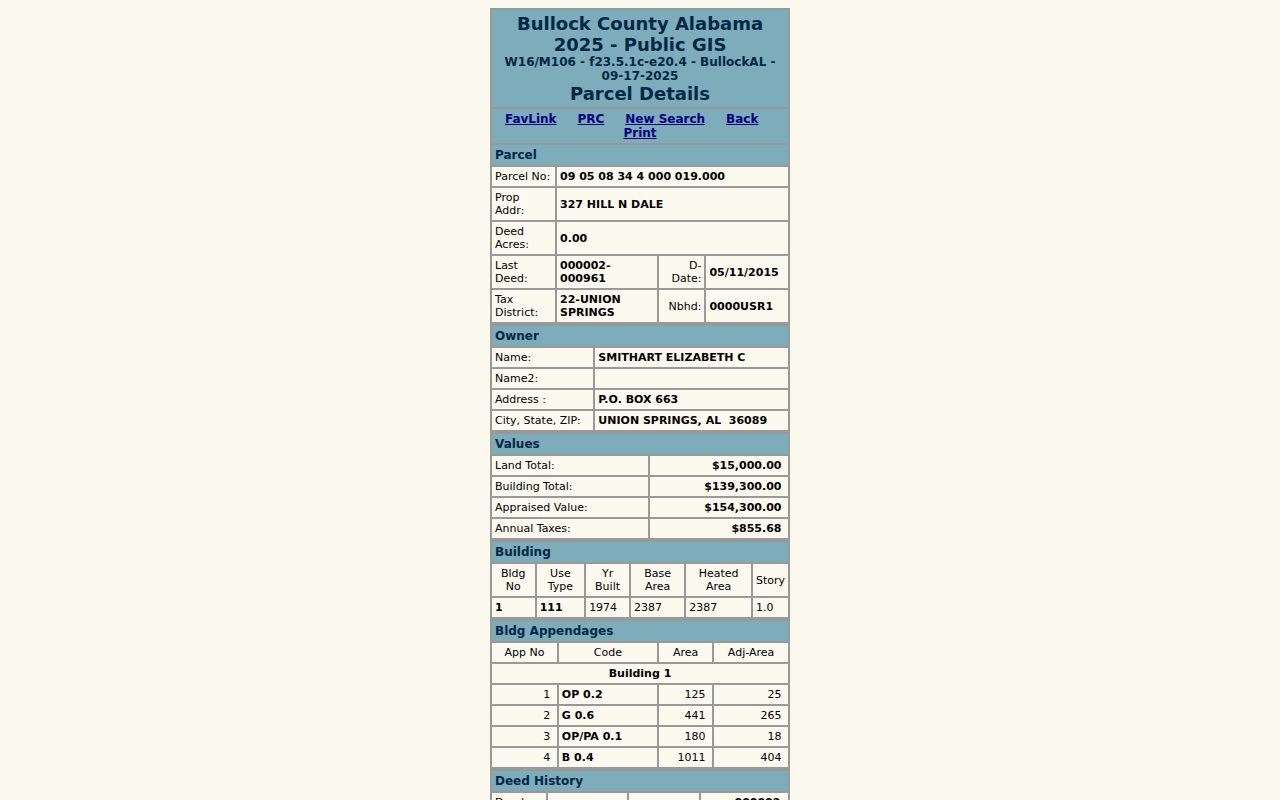
The page displays a history list next to the parcel details. That list is not a certified chain of former owners. Open each instrument at Probate and confirm its parties and legal description before connecting one transfer to the next.
Walk Bullock County's Deed Chain Backward
Start the reverse chain with the newest deed matching the current parcel. Every verified grantor becomes your next owner lead. Search that party as a grantee on an earlier acquisition deed, and keep going. Keep the legal description beside each name. Parcels split or merge, and names repeat across Bullock County deed records.
- Find the current acquisition deed from the parcel's D-Date and D-Inst or book/page.
- Read its grantor, grantee, capacity, full legal description, and prior-deed recital.
- Search that grantor as a grantee to locate the deed by which the former owner acquired title.
- Search forward under each grantor for corrections, reservations, or later transfers.
- Continue at the Probate counter or in books and catalogs when the online trail stops.
- Grantor / grantee
- The conveying party and receiving party named in an instrument.
- Chain of title
- The linked sequence of verified transfers affecting the same land.
- Reverse index
- The grantee-side route used to find how a former owner acquired the property.
- Warranty / quitclaim
- Different conveyance forms whose legal effect must be read in the document.
Match Bullock Book, Instrument, and Land
One Bullock record may cite an instrument string like 00MM-2-000340. The Midway card uses book and page 18-482. Copy each reference exactly. When a search stalls, ask the Probate counter how its formats map to one another. The portal's public landing page lists no verified field inventory or earliest image year.
The legal description is the identity check that never wears out. A platted parcel traces through subdivision, lot, block, and plat references. A rural tract leans on acreage, section-township-range, road and right-of-way calls, and adjoining owners. A current APN can bridge record systems. It may never appear in an older deed, though.
Note: After an acquisition date, search forward under the former owner. That catches corrective deeds, partial conveyances, and later releases.
Estate Names Can Break a Bullock Owner Chain
A former owner can resurface under a different legal label. Estates, personal representatives, administrators, guardians, conservators, and heirs appear in Bullock County deed records. Trusts appear there too. The Probate landing page separates land records from probate cases, so search both whenever a deed signs in a representative capacity or an owner dies before the next conveyance. Probate petitions, wills, letters, sale orders, and settlements explain who had authority to sell. None of them replaces the recorded deed that actually moved the land. Search the decedent's full name, its variants, the estate name, and the representative's capacity phrase. Court files may also surface a quiet-title, partition, or contested-probate case. That can break a tidy chain.
Before Bullock County Existed
Bullock County was formed on December 5, 1866. It was created from parts of Macon, Montgomery, Pike, and Barbour counties. An older deed can therefore sit under a parent county or a state-level description. It may not sit under modern Bullock custody. Union Springs incorporated as early as 1844. Midway's first post office dates to 1838. Those older place names still work as search terms in deed records. The Alabama Secretary of State land-record search spans state land records from statehood through 1950. It supports name, township-range-section, and book searches. Post-1950 county land records may sit with Probate. Treat the state result as a bridge back to the right county book. Do not treat it as proof of a complete modern chain.
The Missing Courthouse Folder Is Only a Clue
The Alabama Department of Archives and History Bullock finding aid includes a folder labeled Courthouse (Missing). That label is a real archive fact. It does not prove Bullock deed books burned, vanished, or share a particular gap. No official courthouse-fire or deed-loss date appears in the state's own records. The same archival collections hold place, church, cemetery, newspaper, Midway, and Union Springs files, useful for decoding former road names or local context. A separate ADAH church finding aid identifies a fragile five-page 1858 Fitzpatrick Methodist Episcopal Church land deed. That deed is a concrete historic property lead. It may involve archive handling or copy rules.
Use Bullock Place Names Across Time
Place names shift, and that hides former owners. Older Bullock records may say Union Spring, Midway, Fitzpatrick, Perote, Roba, Armstrong, Banks, Three Notch, Chunnennuggee or Chunnennugge, Peachburg, Hardaway, Prairie, Washington, or just a route number. A surname alone will miss hits. Run newspaper and archive searches with each variant alongside estate, church, railroad, or sale terms too.
Railroads drove much of this timing. Midway's development began in the early 1870s. Union Springs became a rail junction by 1885. Because of that growth, deeds and plats may reference roads, mills, rail corridors, plantations, springs, or neighboring landowners where a modern address would stand. The ADAH newspaper database filters by county, title, topic, and keyword, though it is a finding route rather than a digitized parcel index.
Historical context supports the deed search. It cannot replace primary transfer evidence. Use a newspaper sale notice, obituary, church record, or local-history folder to pin down a name and date. Then return to the deed book, probate file, plat, or state land record that actually ties the person to the property.
Request Older Bullock Deeds at the Counter
When the online chain breaks, walk into the Probate office with a concise lead sheet. List the current APN and every known prior APN. Add grantor and grantee name variants, book/page or instrument strings, deed dates, subdivision and lot/block, STR, acreage, and the legal description. Then ask directly which deed book, index book, plat book, image system, or microfilm roll covers the next era.
The Bullock Judge of Probate sits at 217 N. Prairie Street in Union Springs, with mail to PO Box 71 and phone 334-738-2250. The authorized INGRecords front end supplies land-record access, search instructions, account signup, and copy functions. Its accessible landing page does not state the earliest indexed year. Confirm current copy costs and certification requirements before ordering.
Some older research leads outside the county. The Alabama Department of Archives and History Research Room may hold what the local books lack. A FamilySearch catalog entry may hold the same. FamilySearch's Alabama wills and deeds collection spans a broad statewide date range. But the metadata does not prove Bullock coverage in every volume or year. Check the catalog image and its provenance. Do this before treating a name as one of the parcel's former owners.
Know Where Bullock Former-Owner Research Stops
The county publishes no earliest year for its online deed index, no complete deed-book inventory, and no stated microfilm cutoff. The CAMA entries from 2006, 2012, and 2015 cover a single parcel and cannot fill that gap. A responsible former-owner search says plainly where the evidence stops and which offline source remains unsearched.
Online-depth limit. Bullock County's earliest online deed year is unverified. Continue with Probate books, staff, state land records, ADAH, or cataloged microfilm instead of treating no web hit as no former owner.
Some chains are too tangled to untangle alone. Stop and bring in a title professional or surveyor when a legal description shifts with no clear split or merger on record, when a recorded image is missing, or when the parties' capacities in a deed leave you guessing. The same caution applies when one name touches several tracts in the Bullock County property records and the parcels are hard to tell apart. Former-owner research still earns its keep. It supports house history, heir research, and purchase diligence through the deed records. Just never use the chain of ownership to stalk or harass a living person.