
Bullock Tax Record Fields
Bullock's public GIS/CAMA system puts assessment and tax facts on the parcel summary and detail card. The compact view runs on labels. Land, Imp, Tl-Mkt, Exmt, and YrlyTax carry the numbers. Opening the detail expands them into land total, building total, appraised value, annual taxes, district, acreage, deed lead, and property characteristics.
| Field | What It Shows | Where |
|---|---|---|
| Appraised value | County estimate before the class ratio | CAMA detail |
| Assessed value | Appraised value multiplied by classification ratio | Revenue assessment |
| Exemption marker | Indicates an assessment exemption field | CAMA summary |
| Annual tax | Tax amount displayed on the inspected record | CAMA card |
| District | County, Union Springs, or Midway assessment area | CAMA search and result |
The parcel cards carry no separate contract-sale-price field. Do not read an appraised or total market figure as the price paid for the land. Dates matter too. Check the parcel year and source date first. A deed's consideration, a mortgage amount, appraised value, assessed value, and annual tax each answer a different question. Only the county office can confirm whether a correction, exemption, or later assessment action has changed the live account.
Bullock Revenue Tax Desk
The Alabama Department of Revenue directory identifies Neara S. Reed as Revenue Commissioner. The office is at 217 N. Prairie Street in Union Springs, with 334-738-2888 and 334-738-2750 listed as phone numbers. The directory links Public GIS, the Parcel Viewer, and Citizen Access.
Assessment access
Search CAMA for owner, APN, district, value, exemption marker, deed lead, and annual tax.
County follow-up
Ask the Revenue Commissioner about corrections, current use, homestead, value notices, and tax status.
Bullock County publishes no separately indexed tax-bill detail portal, no downloadable roll, and no online Board of Equalization docket. Ask the Revenue Commissioner's office for those records.
Bullock Values Follow Alabama Rules
Alabama derives assessed value by multiplying appraised or fair-market value by a class ratio. Millage then applies to the assessed figure. Exemptions can shrink the bill. One mill equals 0.001.
| Class | Property category | Ratio |
|---|---|---|
| I | Utilities | 30% |
| II | Property not in another class | 20% |
| III | Agricultural, forest, qualifying owner-occupied residential, and historic | 10% |
| IV | Qualifying personal vehicles | 15% |
The state example starts from a $100,000 appraised value. A 10% ratio produces a $10,000 assessed value before millage is applied. The numbers illustrate the formula, not a Bullock parcel or the local total rate.
Look Up Bullock Tax Data
Start with the official parcel search. Search by address, owner, or full parcel number, open the detail card, and keep the APN handy because DOR tax-sale transcripts do not list physical addresses.
- Find the parcel and confirm the situs and legal description.
- Read land, building, appraised, exemption, and annual-tax fields.
- Call the Revenue Commissioner for current payment or application status.
- Check Book of Lands and state DOR only when delinquency is at issue.
- Assessed value
- The appraised value after the classification ratio.
- Millage
- The rate applied to assessed value; each mill is one-thousandth.
- Homestead exemption
- Relief for a qualifying owner-occupied primary residence.
- Tax lien
- A claim tied to unpaid property tax.
The screenshot is sourced from the Alabama DOR assessment page.
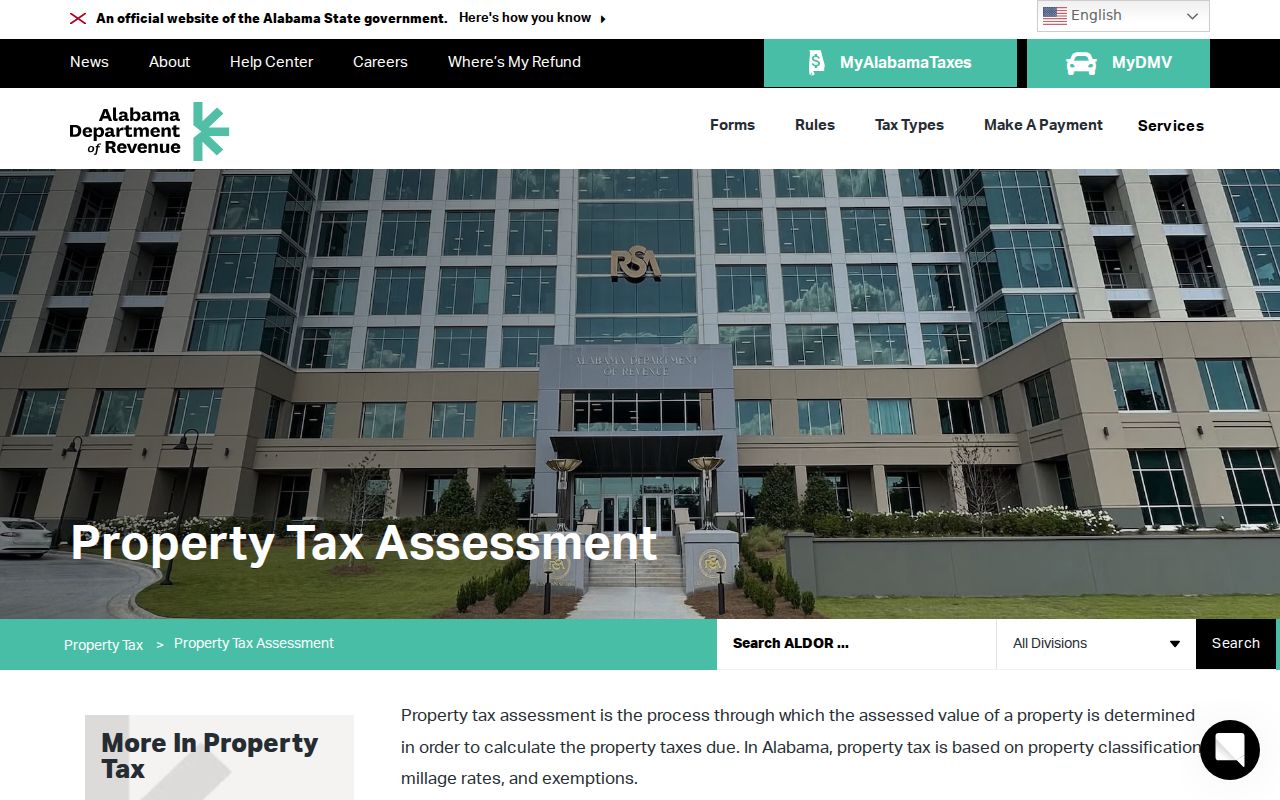
The formula page supplies statewide meaning; the Bullock parcel record and the county office supply the actual local facts.
Bullock Agricultural Current Use
Eligible agricultural and forest land can be valued at current use instead of fair market, but only after an application. A new owner applies from October 1 through January 1 after purchase. Convert the use within two years, and rollback consequences can follow. Class III keeps its 10% ratio. The taxable base may still be lower.
Many rural Bullock parcels have no street address. They turn instead on acreage, the APN, section-township-range, or a legal description. Take those keys to the county office when asking whether an application is active or timely. Bullock County publishes no current-use form online.
Use the recorded deed date to check whether ownership changed inside the application cycle. Bring the legal description and the CAMA acreage. A mailing address alone is not enough. If land use changed, ask how rollback is calculated and which years it covers. The state page gives the general rule. Only the Revenue Commissioner can confirm the parcel's classification, application, and county record.
Bullock Homestead Applications
Alabama's homestead guidance covers an owner-occupied, single-family primary residence on up to 160 acres. Relief varies with age, disability, blindness, and local rules. The application itself goes through the county office.
A CAMA exemption field is only a clue. It is not the application file. Ask the Revenue Commissioner which exemption is coded. Ask what proof is required. Also ask which tax year it affects. A mailing address alone never proves the parcel is the owner's primary home.
State guidance describes an under-65 homestead exemption of up to $4,000 in assessed value. That applies to the state portion. Owners who are 65 or older get different state treatment. So do owners who are permanently and totally disabled or blind. County and local limits still matter. Do not infer eligibility from age, name, or address on a public card. Request current county requirements and submit proof through the office.
Bullock's Four-Year Review Cycle
Alabama DOR describes annual equalization as a review of one quarter of each county per year, completing a full review over four years. Taxes are due October 1. They go delinquent after December 31. Owners remain responsible even when no notice is mailed.
Save the written value notice when it arrives. Compare the detail, land facts, and classification. The four-year cycle explains why figures shift without turning CAMA into a live sale-price feed.
A new deed, a building change, an exemption decision, or a scheduled review can touch different fields at different times. Bullock County publishes no parcel-level CAMA refresh schedule. Ask the Revenue Commissioner which tax year a displayed value serves and whether a later correction or Board action is pending. Keep dated copies when comparing one year against another.
Bullock Delinquent Land Checks
State sources beat unofficial auction lists for delinquent land work. The Alabama DOR's Book of Lands is the better reference. Its guidance puts public auctions on the first Monday in May. Redemption is generally allowed within three years. Treat that as the state pattern, not a Bullock County calendar. DOR transcripts of state-held property are updated weekly. They omit physical addresses. Match on APN, owner, legal description, tax year, and redemption status instead.
A tax-sale certificate and a tax deed are different documents. Neither one alone guarantees clear title. Paying someone else's taxes creates no ownership interest. For state-held parcels, DOR outlines a price-quote request followed by a ten-calendar-day payment window. Distinguish the certificate, the assignment, the deed, and the redemption status from one another. Recorded tax deeds live with Probate. Disputes belong in Circuit Court. Bullock County publishes no official auction notice page, current delinquent list, or bidder instructions. Confirm those details with the county before relying on a general state date.
Protest a Bullock Assessment
File a written protest with the Bullock County Board of Equalization within 30 days of the written notice. The deadline runs from the notice date. Alabama DOR cites §§40-3-20, 40-3-24, and 40-3-25. Keep the notice date, APN, photographs, measurements, classification facts, and comparable evidence tied to your parcel number so the Board can follow the record.
Thirty-day window. File the written Bullock County value protest within 30 days of the notice and confirm receipt with the county office.
The county site names the Board of Equalization but publishes no online roster, docket, or appeal form. Contact the Revenue Commissioner for the current delivery route and hearing process. For a fuller breakdown of tax value versus sale value, see Bullock County property values.
Separate an assessment protest from a tax-payment question. The Board reviews value under the state process. Delinquency, redemption, and payment status live in the tax record and may involve DOR guidance. A recorded deed can confirm when a parcel changed hands and what land transferred. It does not set the county's appraised value. Organize your evidence by the exact issue. Gather parcel facts, classification, exemption, comparable property data, physical condition, or a wrong ownership or description field.
When a CAMA amount differs from a notice, record both dates. Ask which one controls for the appeal year. The portal's 2025 header, the annual equalization schedule, the deed date, and the inspection date are separate time markers. None of them proves the day a parcel field refreshed. The Board record or written confirmation from the Revenue Commissioner is the better source for a decision already made.
Keep proof of submission, any fee, and every hearing notice. If staff correct an ownership, acreage, class, or exemption field, ask when the change will appear in CAMA. Ask which tax year it affects. That habit prevents a common misreading. It stops a later portal display from being taken as proof that an earlier tax bill or Board decision was wrong. Retain the final written response with the notice and the dated parcel record. That paper trail lets the assessment history be reconstructed later.